

Work-related stress affects far more than a person’s mood. It can influence physical health, job satisfaction, productivity, and attendance.
During the COVID-19 pandemic, mental health concerns reached record levels, and many Americans continue to experience emotional strain. Health care workers face particular pressure, with about 45% reporting high levels of job burnout. Work-related stress also accounts for an estimated 8% of U.S. health care costs.
A new study from researchers at the University of California, San Francisco (UCSF) examined whether a simple digital mindfulness program could help employees manage that pressure.
The results suggest that even brief meditation sessions may support better well-being and a healthier relationship with work.
The UCSF Study
Researchers from the UCSF Department of Psychiatry and Behavioral Sciences conducted a large mindfulness trial involving more than 1,400 UCSF employees. Participants received either access to the commercially available Headspace meditation platform or entered a waitlist control group.
The researchers measured several outcomes before and after the program. These included psychological distress, work stress, job strain, burnout, work engagement, mindfulness, depression, and anxiety. They also examined whether participants continued to use the digital meditation program and whether regular practice influenced the results.
The study appeared Jan. 14 in JAMA Network Open.
What Changed for Employees?

Pexels | Employees practicing digital meditation report reduced stress, lighter job strain, and fewer burnout symptoms.
Employees who used digital mindfulness meditation reported meaningful improvements across the study measures immediately after treatment. Compared with the control group, they experienced lower overall stress, reduced job strain, and fewer symptoms of work burnout.
The meditation group also reported:
- Greater mindfulness in daily life
- Higher job satisfaction and reward
- Stronger engagement with work
- Lower anxiety
- Fewer depressive symptoms
These changes did not disappear quickly. At the four-month follow-up, researchers found that many of the improvements remained.
Rachel Radin, PhD, the study’s first author and a psychologist and assistant professor in the UCSF Department of Psychiatry and Behavioral Sciences, said, “Our team found significant, sustained improvements in well-being, job enjoyment and mindfulness, particularly for those who meditated more.”
She added that the findings support earlier research on mindfulness while showing that similar psychological benefits can occur through a digital platform.
Five Minutes May Matter
One of the notable findings involved meditation time. Participants who practiced for at least five minutes each day showed greater reductions in perceived stress.
That does not mean five minutes guarantees a specific result. Instead, the finding points to a practical feature of digital mindfulness: employees may not need lengthy sessions to begin building a regular practice.
Smartphone-based meditation also removes some barriers associated with traditional workplace programs. Employees can access guided sessions when their schedules allow, without attending an in-person class. The digital format can also deliver standardized instructions to a large number of people.
Why Mindfulness May Help
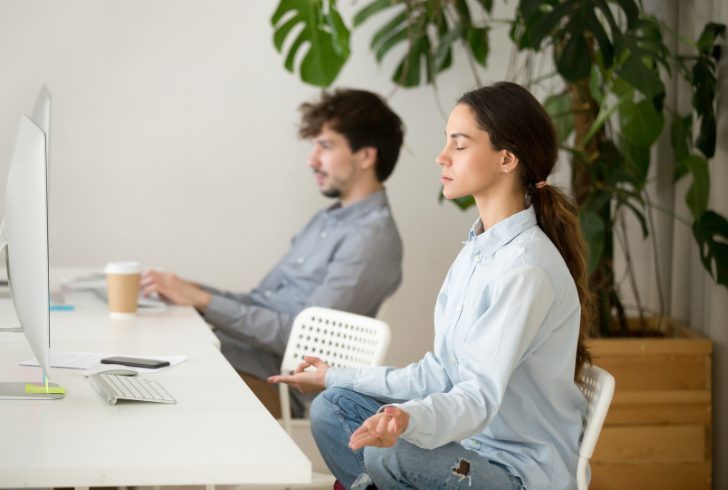
Freepik | By centering your attention on the present, mindfulness helps you navigate stress with thoughtful awareness.
Mindfulness focuses attention on the present moment rather than allowing the mind to remain caught in stressful thoughts. Regular practice can encourage people to notice their reactions and respond to difficult situations with greater awareness.
Aric Prather, PhD, study co-senior author, the Pritzker Family Fund Endowed Chair in Health and Community, and a professor in the UCSF Department of Psychiatry and Behavioral Sciences, explained that the benefits may come from a stronger ability to cope with stressful situations and positively reappraise them.
“Digital mindfulness appears to be a low-cost, low-burden way of improving employee health at scale,” Prather said.
The researchers noted that future studies should examine ways to improve adherence and better understand exactly how these interventions produce their effects.
Mindfulness Beyond Workplace Stress
The potential value of mindfulness extends beyond routine work pressure. Elissa Epel, PhD, another study co-senior author, serves as the Sarlo-Ekman Endowed Chair in the Study of Human Emotion, professor, and vice chair in the UCSF Department of Psychiatry and Behavioral Sciences.
Epel said mindfulness can help people cope with acute stress and may reduce the long-term effects of trauma and loss on mental and physical health.
She pointed to psychological first aid efforts following the Los Angeles wildfires as one example. In those situations, mindfulness can serve as a grounding technique. Focusing on physical sensations such as touch, sight, sound, or breathing can redirect attention away from anxious thoughts and toward the present moment.
That shift in attention may help calm the nervous system during periods of intense stress.
The UCSF findings suggest that digital mindfulness can serve as a practical tool for managing workplace stress. While meditation cannot address issues such as excessive workloads, staffing shortages, or long hours, it may help employees respond to stress more effectively.
The researchers also noted that future studies should focus on improving participation and understanding the specific mechanisms behind these benefits.